Showing posts with label Girl Scouts. Show all posts

Wednesday, November 7, 2012

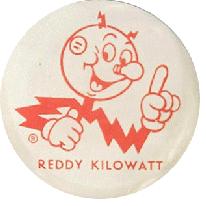
Reddy Kilowat: A Bolt from the Past

Reddy Kilowatt

          Reddy Kilowatt was his name and appearing on everything FPL was his game.

e-bay
      In 1965, my Girl Scout troop took a cooking class for children conducted by FPL in a building that's now part of Palm Beach Atlantic University in downtown West Palm Beach. Wearing little white aprons, we stirred and mixed and learned all about the fascinating world of electric appliances. Does anyone even have classes like that anymore?

          Reddy had arms and legs of lightning bolts, a huge bubble head with a light bulb for a nose and wall outlets for ears.   He was a cutie and he was all over the handouts we were given. He's nowhere around FPL these days and when I tried to call the company for some information, I didn't get a call back. My, how the mighty Reddy has fallen.

reddykilowatt.org
         So I did what any self-respecting obsessed curious person would do--I went internet surfing. I was surprised to find out Reddy wasn't unique to Florida Power and Light. Created by Ashton B. Collins in 1926, the figure was trademarked and licensed to "more than 150 investor-owned electric utilities in the United States and at least 12 foreign countries" according to the unofficial website reddykilowatt.org.

          Sadly, you won't find Reddy on company handouts in Florida these days. The company has gone to a circle with a lightning bolt across it with the letters "FPL" next to it. Not nearly as fun. Collectors can still find Reddy on e-bay and probably at the occasional garage sale.  As I write this, there are over 430 items up for bid.

           Um.... gotta run. I'm running out of time to bid on the "Vintage 1950's Reddy Kilowatt "Trudy Tenderfoot Meets Reddy Kilowatt" Cook Book. 


Wednesday, August 22, 2012

S'mores, Scouts and Summer Camp


      Anyone remember the taste of a campfire s’more? The taste of a gooey, slightly burnt marshmallow and melted rich Hershey’s chocolate nestled between two graham cracker squares as the flavors hit the tongue? Take a bite and rich sweetness oozed out the other side. I sure remember and I remember where I first tasted the treat that can send me back to my childhood with one bite.

     I spent parts of three summers at Camp Welaka, the Girl Scout Camp nestled next to the Village of Tequesta and Jonathan Dickenson State Park just over the Palm Beach/Martin County line.  These days, it’s a simple drive through a nice residential area to reach the camp gates. In the 1960s, the drive took a long time as we headed into what appeared to me to be total wilderness. I was excited to finally see the two pine trees that framed the road into camp. A wooden sign over the road declared that this was “Camp Welaka.”  “Welaka” means “Chain of Lakes” in Seminole and was the final choice of several suggested names for the camp. Generations of grown up Girl Scouts still smile whenever they hear that name.

We lived for letters from
home--even if home was
only fifteen minutes away!
     During my weeks at camp, the girls in my unit hiked, worked feverishly on crafts with yarn, popsicle sticks, paints and plaster-of-paris.  In the evenings, we gathered around campfires to sing songs like “Make New Friends (But Keep the Old)” in rounds.  With the pungent smell of mosquito repellent and suntan lotion in a thick cloud around us as we sang, we sat close enough to feel the heat on sun kissed faces and toasted our marshmallows on saw palmetto stems cut and carved to a sharp point. We cleaned up in open air showers, wooden walls for privacy and the often cold water helped wake us up.  We swam and took swimming lessons in the man-made lake safely within the three-sided dock complete with lifeguard stands. We piled into vans and headed over to Jupiter Beach to tip toe down the coast, flashlights unneeded in our hands in the bright moonlight as we hunted for turtles laying eggs and stood silently in wonder when we found one.

One of the more pleasant
visitors to our tent.
      The last year I camped there, we learned everything anyone could ever know about canoe safely in preparation of the big trip down the Loxahatchee River across the Jupiter Inlet that only the oldest girls took each summer.

       Girl Scouts came to the area long before my involvement. In a wonderful (but now out of print) book titled, Footprints in Time, author Claudet Benton, herself once a Girl Scout, fills us in on the story.  According to Claudet, it was January 1920 when the president of the national Girl Scouts “called a meeting at the Women’s Club on Flagler Drive in West Palm Beach to organize Girl Scouting in the Palm Beaches.” That meeting was followed by a national charter issued on May 5, 1920 which was the first in Florida. The initial troop had 47 teenage girls as members. 

       Claudet states that Camp Welaka itself is actually the third, and most successful of the Girl Scout camps in northern Palm Beach County. The first, Camp Schaum-a-Hatchee, was in the same area, but was destroyed by the hurricane of 1928 shortly after the first, and only, camp session.  It was followed by Camp Margery Daniels on the same property on the Loxahatchee. That camp was open from 1929 until 1935, when it closed due to the aftereffects of the Great Depression.  Soon thereafter, funds were raised and camp re-opened and stayed open until it property had to be expanded in 1939 to handle all of the Scouts who wanted to camp.  After closing briefly in 1946 during a polio scare, the Camp remained open until 1958 when “The New Site,” now known as “Camp Welaka,” opened for campers. 

          Meals not cooked over a campfire were and are served family style to campers sitting at large wooden tables in the main lodges. There is a stone fireplace in the room made with stones salvaged from the fireplace at Camp Margery Daniels. Over the fireplace is a polished metal plaque mounted to the wall that carries this inscription:
“I have given you shelter only. For the atmosphere and spirit which will prevail here you will be responsible. If you would make me happy bring from the woods the loveliest of flowers and shrubs and surround your camp with the beauty of growing things. Margery Daniels”
       Ten years ago, I sent my daughter to Camp Welaka and once again my feet touched the wooden  floor boards of the main lodge. The path to the camp has changed in the intervening years and the area surrounding the once remote main gate now has homes in all directions. But when I picked my daughter up from her week at camp and stood with her in a song circle next to the flag post at the main lodge, my mind took a leap into the past. If I had not been holding her small hand in mine, it could have been 1967 all over again.

There’s a good reason Girl Scouts continue to exist and continue to gather at Camp Welaka. The women who started this whole thing in Florida in 1920 saw the future and made it happen. Then, as now, girls head into the woods to learn all of those wonderful things about nature that we tend not to notice as we hurry about our day-to-day lives.

August 30 is National Marshmallow Day.  I’ve got some marshmallows. Who’s up for a s’more? 

Copyright (c) 2012 Ruth Hartman Berge
This article first appeared as the August "The Florida You Don't Know" column with Seabreeze Publications, Inc. 


Thursday, December 15, 2011

Christmas in Dixie


Picture Courtesy of David Joyce
           Although versions of the Christmas in Dixie parade were happening as far back as the 1920s, the parade became an institution in northern Palm Beach County during its run from 1954 until the early 1990s. Spectators had to get to the parade route an hour before it started to claim space on the curb.
          My family settled in for the long wait along the parade route reeking of sunscreen because in Florida, despite the calendar saying December, it’s often hot and sunny.  When cars trickled to a stop, my brother would dash into the four-lane street along with twenty other little boys looking for the start of the parade.
When we could hear faint music, everyone would stand up and elbowing each other, crane our necks around and over each other in order to see the very beginning of the parade. The American flag appeared down the street first in the hands of the color guard, the local R.O.T.C. or the Veterans of Foreign Wars. Everyone lining the parade route would stand quietly, hand over heart in respect. The dad hand would be attempting to reach and smack anyone under age ten who wouldn’t stand still or dared to speak.
          The first modern Christmas in Dixie parade was organized in 1954 in Riviera Beach by Jerry Kelly. By 1969, the Palm Beach Post was calling the Christmas in Dixie Parade the “Biggest Florida parade outside of the Orange Bowl spectacle.” That year, the Christmas in Dixie parade included “clowns, twirlers, motorcycles, floats, fire engines, horses, dogs, six bands and a lion.” Also on board was the “Miami Mummer’s Band.” It may not have been televised like the Orange Bowl which went out over the airwaves to TV sets all over the country live from the streets of Miami, but we sat in awe on the curbs and danced in excitement anyway.
          We did our part as spectators, waving at the kids on the floats and anyone in the parade who glanced our way. We danced when the marching bands came by and we ooed and ah’d where expected. We bought souvenirs from the vendors who walked up and down the street selling cotton candy and other things we tried to convince our parents were necessary to life.
          The Girl Scouts and Boy Scouts marched in uniform, waving at the crowd. Local gymnastics schools had participants flipping down the street. Hordes of baton twirlers twirled as they marched. The local fire departments had their oldest trucks decorated and in the parade. Local celebrities and a Grand Marshall sat with sashes and flowers in the backs of convertibles. All the high school bands performed. They would march by with sweat beading on their faces, proudly playing “Jingle Bells” or their school fight song.
          The luckiest participants were those that rode on floats. Church groups would spend weeks building elaborate nativities and holiday displays on flat bed trailers covered with chicken wire. The children of the church would ride clinging on for dear life while singing Christmas carols at the top of their lungs in order to be heard. For some unknown reason, they were usually put right in front or behind one of the high school bands.
There was a Miss Christmas in Dixie and she and her court had a float all to themselves. The queen and her court were required to wave regally when they weren’t tossing candy to the kids along the route. By the time they reached the end, arms were aching and Christmas cheer was in short supply.
          The very last entry in the parade was always Santa Clause. When kids saw his flat bed trailer decked out with a huge gold throne and eight tiny reindeer mysteriously hovering in the air coming down the street, sheer ecstasy and pandemonium would erupt. It meant that it was finally, officially, Christmas season. We only had a few more weeks to keep trying to be good.
Behind Santa’s float, the real world came back and people who had finished watching the parade at the beginning had lined up in their cars and patiently followed Santa’s float across town. More than one kid riding in the back of their parent’s station wagon would wave at the spectators like they were a big shot in the parade themselves.
          In the early 1990s the much loved Christmas in Dixie parade met its sad end when, in a fit of jealousy over a boy, a teenage girl near the end of the parade route threw a bottle at her rival who was marching in the parade. During the riot that followed, it was estimated that 750 to 1,000 people were arrested. That, along with rising costs, led to the demise of the best small-town spectacle I can remember.

Tuesday, August 9, 2011

Suni Sands and Dubois Park

            In the 1970s, when a Girl Scout was old enough to camp at the Outpost campsite in Camp Welaka in Tequesta, there was one event that was special and looked forward to by every camper—the canoe trip down the Loxahatchee River and across the Jupiter Inlet. We would pile in canoes and energetically head down the river. When the Scouts hit the inlet, the current rushing out to sea became much harder. We would push as hard as we could to avoid getting pulled out into the ocean. Alongside our canoes, dolphins cavorted beside us as we crossed, as if they knew we were nervous about the open ocean to our left.
            Across the inlet, we made landfall at Suni Sands, the mobile home park that sits nestled between State Road A1A and the water. There, we would enjoy a wonderful picnic lunch and relax before beginning the hard row back to camp.
            I recently attended a fascinating presentation by Christian Davenport, Palm Beach County Historical Preservation Officer and Archaeologist, and learned that the Suni Sands mobile home park is actually located on top of a prehistoric Indian village site—a rare “double platform mound” where the biggest of chiefs once lived.
            The Suni Sands property was at one time owned by William and Emily Sperry of S&H Greenstamps fame (for those of you who remember when Publix passed out little green stamps with every purchase). In the late 1800s, before Sperry bought the property, the main entrance of Suni Sands was the roadbed of the northern terminus of the Jupiter and Lake Worth Railroad, better known as the Celestial Railroad.
            Close by to the east is Dubois Park which was once called “Stone’s Point.” For two years, the Point had been occupied by a Major Stone and his crew who were trapped in the Intracoastal when their ship was forced to take shelter there by a storm. The Inlet closed when the storm re-arranged the sand, trapping the ship and requiring them to wait it out.  Harry Dubois arrived in 1892 and purchased the Point.
            The Dubois house was built in 1898 on top of a huge shell midden.  About two-thirds of the original midden was sold to create road beds in Harry Kelsey’s dream, Kelsey City (now Lake Park).  The big mound the house currently sits on is but a small portion of the approximately 600 foot mound, yet you can still see a gentle swell to the landscape where the mound was located.
            My friend, Kelly Farrell, who grew up in Lake Park, asked me if I remembered when the Dubois still lived on the property. One of the Dubois would come out when cars would pull up, and as Kelly and her brother Kip hung out of the windows, the Farrells would be charged a dollar for the carload to park and enjoy the beach.
            You can drive by Suni Sands, but it is private property. Dubois Park is now part of the Palm Beach County Parks and Recreation Department.  The Dubois Pioneer Home, first restored by The Loxahatchee Historical Society in the early 1970s, was severely damaged in 2004 when Palm Beach County suffered four hurricanes and it has not yet re-opened to the public. Repair and restoration is ongoing thanks to the generosity of The Loxahatchee Guild.  The Parks and Recreation Department has a “Gift to Parks Program” and would be delighted to speak with you as to where you might volunteer your time, talents or dollars to help in the continued restoration of the park and buildings. Contact Tim Gramowitz at (561) 966-6651.  
            Dubois Park itself is open to the public…and you don’t even have to have a spare dollar.

This article was published as the August column of "The Florida You Don't Know".